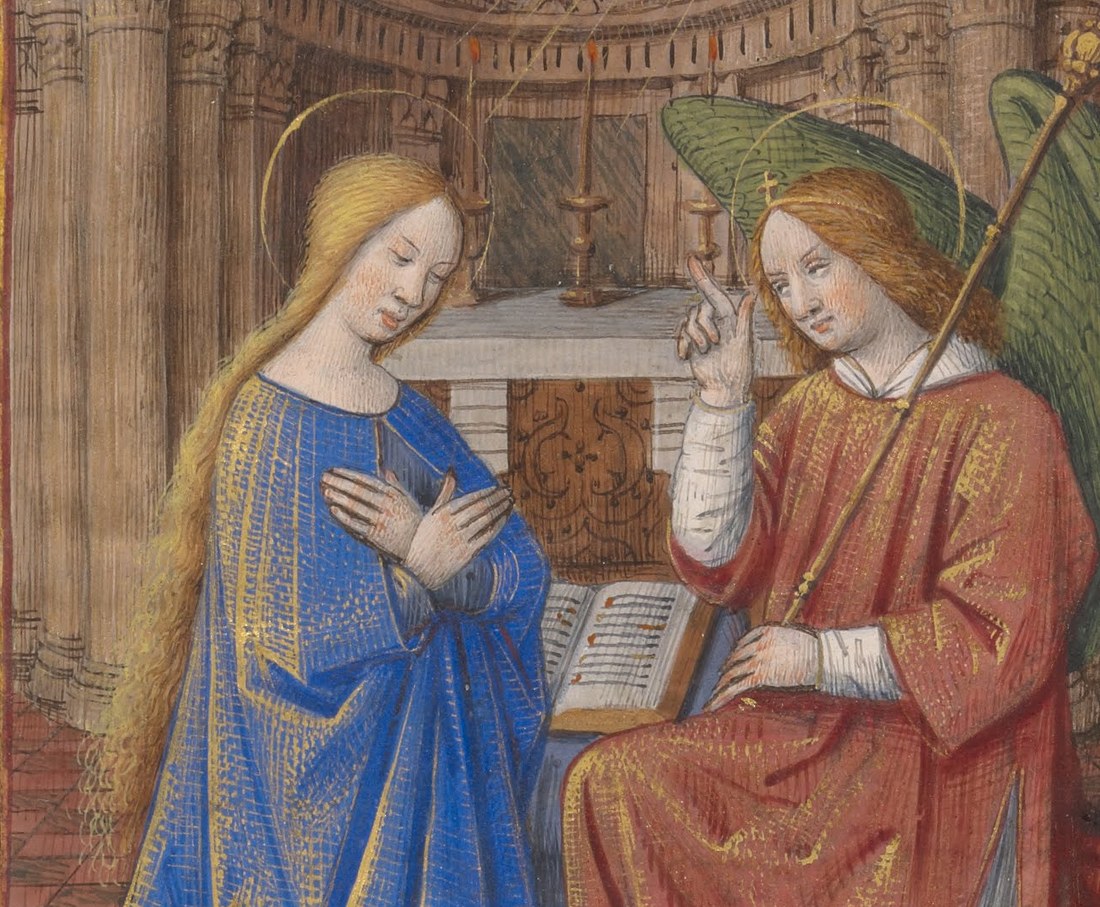
For now we see in a mirror dimly, but then face to face. Now I know in part; then I shall understand fully, even as I have been fully understood.
1 Corinthians 13:12

Speculum Iustitiæ · Málaga Cathedral, c. 1771
The device of the press
For now we see in a mirror dimly, but then face to face. Now I know in part; then I shall understand fully, even as I have been fully understood.
1 Corinthians 13:12
Speculum Iustitiæ · Málaga Cathedral, c. 1771
The device of the press
The device of the press is a title of Our Lady from the Litany of Loreto. The litany gives the title its medieval form, but the image it uses is older still: the spotless mirror of the Book of Wisdom, where divine Wisdom is called a reflection of eternal light and an unblemished mirror of the working of God, and the reading the Church gave that image when she saw it answered in Mary. By “justice” the Church does not mean fairness in our dealings but sanctity itself, the whole of holiness. She is the Mirror of Justice because she gives back the holiness of Christ and keeps no light of her own. That is the vocation of a faithful book, and of a faithful press: to return a light it did not make, adding nothing and hiding nothing.
John Henry Newman states the meaning of the title as well as anyone.
Here first we must consider what is meant by justice, for the word as used by the Church has not that sense which it bears in ordinary English. By “justice” is not meant the virtue of fairness, equity, uprightness in our dealings; but it is a word denoting all virtues at once, a perfect, virtuous state of soul—righteousness, or moral perfection; so that it answers very nearly to what is meant by sanctity. Therefore when our Lady is called the “Mirror of Justice,” it is meant to say that she is the Mirror of sanctity, holiness, supernatural goodness.
Next, what is meant by calling her a mirror? A mirror is a surface which reflects, as still water, polished steel, or a looking-glass. What did Mary reflect? She reflected our Lord—but He is infinite Sanctity. She then, as far as a creature could, reflected His Divine sanctity, and therefore she is the Mirror of Sanctity, or, as the Litany says, of Justice. Do we ask how she came to reflect His Sanctity?—it was by living with Him. We see every day how like people get to each other who live with those they love...
Now, consider that Mary loved her Divine Son with an unutterable love; and consider too she had Him all to herself for thirty years. Do we not see that, as she was full of grace before she conceived Him in her womb, she must have had a vast incomprehensible sanctity when she had lived close to God for thirty years?—a sanctity of an angelical order, reflecting back the attributes of God with a fulness and exactness of which no saint upon earth, or hermit, or holy virgin, can even remind us. Truly then she is the Speculum Justitiæ, the Mirror of Divine Perfection.
John Henry Newman, Meditations and Devotions (1893). Read the full meditation →
The title is older than the litany that gathers it. Long before Loreto the Church Fathers saw in the Virgin a glass that gives back a light not its own. St. Ambrose taught that the beauty of Mary’s holiness shines out from her life as from a mirror, her life set before us like a picture, so that virtue, taught by her example, shows the soul what to do and what to avoid. He fixed the thought in a figure the press has taken for its own. A house should be beautiful even before you reach the door, so that its face does not deceive: what shows on the outside answers to what waits within, and once you are inside there is nothing dark. In the same way our mind, when it is not caught in the shadows of the body, discloses its inner light to the world. The mirror makes no claim about Mary’s power, only about her clarity: she reflects perfectly because there is nothing in her to distort the image. It is what the press hopes for in every book: that its outward beauty is not a mask but a true sign of what lies within, and that the reader, drawn first by the made thing, is led through it to the truth it carries, and through that truth to its source.
St. Ambrose of Milan, De virginibus 2.6–16.